Thirsty for information about Alaska Real Estate? Whether you're a home buyer, seller, investor, or just curious, we've got you covered! Comments and questions are welcomed!

March 22, 2016

Monopoly - Real Estate Lessons

            I was playing monopoly this weekend – you know, the old-fashioned board game with paper money, iconic pewter playing pieces and nostalgia of childhood epic-fun and crushed dreams.

            The first game, I was playing very conservatively. If the property didn’t fit my exact needs and wants, I didn’t buy it. I figured, “Ehh, I’ll wait a round and after passing go, when I have some extra spending money, I’ll snatch it up.” I was saving my money and opportunity to land on Park Place and Board Walk, the Holy Grail of monopoly real estate.

            Wouldn’t you know it, after a few strolls through the block, I was able to control the most valuable real estate. Now it was time to amass my empire and erect new construction houses, and develop some hotels. Just as my world was reaching new levels of economic development, something else was taking place I didn’t realize.

            My wife had complete control of a good majority of the board. Over half of the first portion of the board was now covered with one or two houses – later I would come to call this portion of the board, “Death Row.” Her tactic was buying anything and everything she could afford. She was making any opportunity afforded to her work.

            I was able to dodge some of her properties, luckily landing on “Chance” and “Community Chest.” After a while, she landed on Board Walk. I felt pretty proud to be collecting $500+ in rent, and felt the start of my reign as The Monopolist.

            Soon after collecting my biggest rent check, I started to feel the slow bleed of her single and double-housed properties. The same low-end properties, which I scoffed at, were now getting the best of my checkbook. Almost overnight, I began to barely scrape by, having to mortgage everything I owned. Suddenly my empire began to crumble, and hers began to rise. Her “Death Row” was now laden with hotels and my only hope was to go to jail, AKA sit in the corner and hope the world would suddenly change for the better.

            Needless to say, I lost my houses on the most prestigious properties, and was out of the game quickly. I lost it all. This taught me some very valuable lessons about real estate.


            Firstly, when you start out in the real estate game, it’s all about wealth building. Its like Robert Kiyosaki says in part of his strategies (Author of Rich Dad Poor Dad), there’s a time to manage wealth, and then there’s a time to build it. When you’re just starting out, you should be trying to control as much real estate as possible. This, at times, means you might need to be highly leveraged.

            Secondly, you should diversify your real estate portfolio. I’m not saying branch out into stocks and bonds, but spread it evenly between property types. Don’t only invest in high-end properties that fit your specific criteria. This will not make you bullet proof. To those of you who say diversify across all platforms, take a lesson from Warren Buffet who said, “Diversification is the lack of knowledge.”

            Thirdly, don’t let the state of the economy dictate your actions. If you are at a point in your life where it makes sense to build wealth, build it. Do not wait on the sidelines at hopes the world around you will change – make it change. There are always opportunities out there, you just have to keep an eye out and be persistent. Think of it like the people who want to lose weight, and wait for Monday to come to start their diet. Mondays never come!


            After licking my wounds, we played a second game. This time, my strategies shifted. I began to barely scrape by in the beginning, while picking up as many pieces of property as possible. This time, I was building my wealth and I was very highly leveraged.

            No longer did I have specific criteria of property, I just bought it if it made sense. The game went much differently this time. My wife, who already implored an awesome strategy, was battling with me for control. After a little bit of luck, and some application of my knowledge, I was able to dominate the board, all without the two properties I had coveted so highly before. Before long, I was able to exact revenge and relive my gloating seven-year-old-self as the Monopolist.


            Monopoly also taught me some other valuable nuggets of real estate wisdom, but that’s for another time!


For information about Real Estate in Alaska, contact our local Real Estate Expert James Cash at (907)-360-7448 or e-mail at jamesfcash@gmail.com

Posted in Education
March 15, 2016

Anchorage Real Estate Supply and Demand

Anchorage Real Estate Economy

Supply and Demand


            It’s really Econ. 101, Supply and Demand. It sounds pretty straight forward, but what are the factors that surround this? Let’s take a closer look to extrapolate whether or not we can forecast the future.

            Firstly, let’s identify a few exogenous determinants of real estate demand:

·      Market Size (Population and Employment)

·      Income/Wealth

·      Prices of Substitutes

·      Expectations

Market Size

            Two of the biggest factors that drive market size are population and employment. For instance, the bigger the population, obviously the more land and livable dwellings needed. If this shrinks, just the inverse will happen. Secondly, employment or output will be the second major factor in market size worth mentioning. If unemployment rises dramatically, more homeowners will be in higher rates of default, pushing them out of their houses and into the rental market.

Income / Wealth

            In relation to residential real estate, average GDP, or income will affect the price of homes in relation to goods being kept at a constant price. In laymans terms, if the cost of goods (utilities, groceries, gas, ect.) remain the same, while the income of the average person rises, they will have more available money. In a market with limited amount of homes, land and new construction (Anchorage for instance), average price per square foot of dwelling residence will go up, i.e. the cost of homes will rise in accordance with this. Conversely, if the average GDP of consumers falls, we can expect that the average price per square foot in the residential sector will also fall in a scalable manner.

Price of Substitutes

            In a market with limited available land, substitutes for homeownership often become higher – enter the rental market. Currently, rental prices in Anchorage are at a high. This makes the residential sector also have a higher shift. If substitutes (rents/rentals) are high, this makes owning a home more desirable, thus putting more demand on affordable homes, making inventory scarce and prices high.

Consumer Expectations

            Believe it or not, but in a closed market, consumer expectations can play a major role in the economy. For example, if it were widely thought that the price of gold or copper will go up due to a downshift in mining production (inventory), the price may rise and even effect other goods such as consumer electronics. If time comes to pass and production does not take a downturn, consumers will have paid a premium due to expectations that did not actually come to fruition.


Actuality of These Items


            If anyone tells you the end is coming, you might not want to believe him or her. No economist has a crystal ball, and people as a whole scarcely, accurately predict shifts in the economy.

            What we do know is that according to the Anchorage Bureau of Labor Statistics, last accurate data we can confirm is that the Anchorage unemployment rate is 5.3% (April 2015). Our population currently boasts just north of 300,000 people. In January of this year, according to the Department of Labor and workforce Development, there are 153,600 residents in anchorage with nonfarm employment (January 2016). Although data.ocala.com suggests there are 197,990 total in the workforce.

            During the great depression in the U.S., the unemployment rate as high as 25%. For us to see unemployment rates that high, we would have to lose around 40,000 jobs…that are a lot.

            We also have a buffer as an economy. If jobs are lost quickly, we can probably see the substitute market decrease, acting as a shield in the real estate economy. This will soften the prices of the residential real estate market, and increase inventory. It is worth noting that inventory, currently, is relatively low compare to a “healthy” market.


What We Do Know

            What we do know is that gas and oil is a commodity with limited availability, it will run out. Also we can see that employment from oil and gas impact state funding more greatly than it does consumer spending within the state (http://live.laborstats.alaska.gov/ces/ces.cfm?at=04&a=000020&adj=0#y2001).

            Land in Anchorage will always be scarce. There is just not much more buildable land that is available. This means that the population would have to leave in droves, tens of thousands of people at a time, for us to see a sizeable recession. If that is the case, it will be a momentary shift in the economy (in the grand scale of things). If this does happen, it will be time to buy for sure.


Wise Words From a Friend

            I had a friend tell me that they investing in the residential real estate market in San Francisco in the early 90’s. His home appreciated almost $30,000 in three years, from $165,000 to $195,000. He thought he had hit the height of the market, and there was talk of another collapse. He sold his home quickly in a hot market and thought to be the wiser.

            Today, if he still had his home, he told me it would have been worth over $500,000. He thought for sure the shift was coming (as many people had told him).

            The advice I give people is, make educated decisions based on your current condition. If it is a good move for you to sell today, sell today. If it is a smart move for your family to buy today, buy today. The mantra of, “We’ll see what the future brings” is that of some one who sits on the sidelines. To invest in your future, you must be proactive and not reactive.


- James Cash 

March 10, 2016

Cook Inlet Lending Center - Down Payment Assistance Program

Cook Inlet Lending Center

Down Payment Assistance Program (DPA)

Updated February 17th 2017 

            If you’re looking to buy a home in Anchorage, Eagle River, Wasilla and Palmer, this program may be for you. If you’re tired of renting your home, apartment or condo and not getting any return on that investment, you stand alongside a lot of other home buying hopefuls. What is one of the biggest hurdles to jump when buying a home? A down payment. The Cook Inlet Lending Center (CILC) is a new program offered for the Municipality of Anchorage, Mat-Su Borough and the Kenai Peninsula Borough.


Who is eligible?

The CILC is targeting individuals and families with low to moderate income with this down payment assistance program. You must be a part of the aforementioned Alaska boroughs. For more information about the program pertaining to income limits, please see the household size and maximum income limit below.


How it works

            The CILC down payment assistance program is basically a second mortgage for 20% of the loan, financed at 4% over 30 years. 4% is a ridiculously low interest rate that is fixed over the life of the loan! Borrowers will pay Cook Inlet Lending Center monthly for principal and interest, just like your typical loan. For full information and criteria please e-mail inquiries to jamesfcash@gmail.com, subject CILC Lending Program.


You should act NOW

            This down payment assistance program is limited on its funds, and is basically a first come first serve basis. At some point in the year, their funds will run out and could potentially be indefinitely postponed. Last year (2016) funding ran out by August. If you to take the time to get pre-qualified, they do guarantee your funds even if you do not close on your property until later in the year, so act now!


Overview

            This is a great down payment assistance program for Alaskans, specifically targeting Anchorage, Mat-Su Valley and Kenai. The Cook Inlet Lending Center program will allow first time home buyers without the money for a down payment, that show lending responsibility the power to get into the house of their dreams.


To start browsing at Anchorage homes, click here!

To start browsing Mat-Su homes, click here!


For more information about real estate in Anchorage, Eagle River and The Mat-Su Valley, contact our local expert James Cash at (907)-360-7448.

Feb. 29, 2016

2016 Palmer Alaska Real Estate Statistics

2016 Palmer Alaska Real Estate Statistics

February 29th, 2016


Below are the residential real estate sales statistics for Palmer, Alaska.


What we can draw from these statistics in Palmer is that the market is moving a long nicely. 


We can see that the inventory supply is very low. The closer we get to 6 months of inventory in any market tells it's a relatively healthy market for both buyers and sellers. This means that properties may tend to favor the seller in this market, since there is such a short supply for buyers to pick from. It could be time to sell in Palmer!

James Cash

Properties of Alaska

907-360-7448

Feb. 29, 2016

2016 Wasilla Alaska Real Estate Statistics

2016 Wasilla Alaska Real Estate Statistics

February 29th, 2016


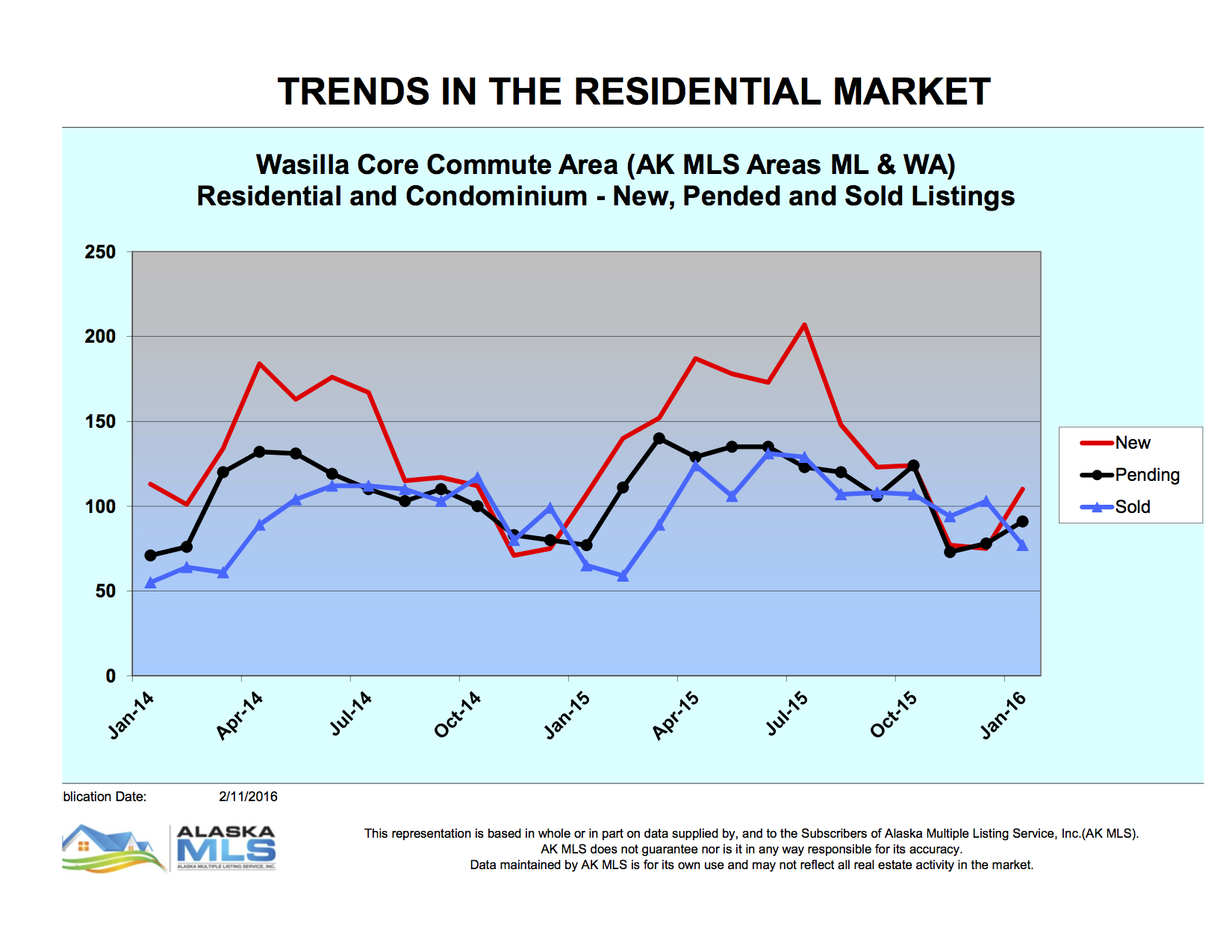
Below are the residential real estate sales statistics for Wasilla, Alaska.


What we can draw from these statistics in Wasilla is that the market is moving a long nicely. 


We can see that the inventory supply is a bit heavier than Anchorage, which is a good thing. The closer we get to 6 months of inventory in any market tells it's a relatively healthy market for both buyers and sellers.

James Cash

Properties of Alaska

907-360-7448

Feb. 23, 2016

Bank of America's New 3% Down Loan Program

Bank of America's New 3% Down Loan Program

Bank of America recently launched a new loan program that offers only 3% down to first time home buyers. The difference between this home loan and other moderately low down payment programs is that there is no private mortgage insurance (PMI). This could save borrowers thousands of dollars of the life-span of their loan, there are a few caveats though:


  • 660 Fico Credit Score
  • Cannot make more than median income in area
  • Must be borrower's primary residence
  • First time home buyers must take an education class

Although this loan program sounds more appealing than most other programs out there, don't rush to Bank of America just yet. The PMI is offset due to a higher interest rate over the life of the loan or a big upfront one time fee. This could also create some problems for investment companies and home owners alike. Since there is no mortgage insurance, tax payers will most likely have to take the hit due to defaulting home owners. Also, the same home owner will own less equity in their house at first, making higher payments and resale more difficult for them in the interim.


For more information on Anchorage, Eagle River and Wasilla real estate markets, contact our local expert James Cash at (907)-360-7448


Feb. 20, 2016

February News Letter

Feb. 11, 2016

Anchorage Alaska Market Inventory Report

Anchorage Alaska Market Inventory Report

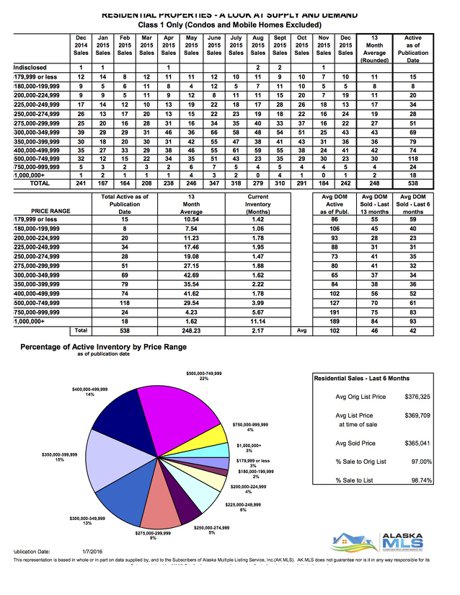
Below is a brief summary of what the real estate market is doing in Anchorage, Alaska. Please note this is for single family homes and does not include condos, townhouses, or apartments (for that info please feel free to reach out to us).


Most analysts will say that a healthy market has about six months of real estate inventory. As you can see, in the hottest housing markets ($300,000 to about $500,000) we only have an average of a little less than two months! What does that mean? For sellers looking to sell right now, expect your house to sit on the market for less than two months.


It is worth noting that as we extend into the summer months, inventory will rise and these numbers will be momentarily skewed (unless you look at a year average).


We can also say that if your house is around the $200,000 price range, expect a quick sale as your average days on market appears to be the lowest in the market currently.

Lastly, I would also like to say if your house is sitting on the market for much longer than expected as predicted by the indicated numbers, you are most likely overpriced!


Remember, when selling a home it boils down to a few key factors: price, market and advertising - probably in that order.


Sincerely,


James Cash

Properties of Alaska

Feb. 10, 2016

2016 Anchorage, Alaska Economic Forecast for Real Estate

New Vlog! Interested to see what the Anchorage, Alaska Real Estate market will do in 2016? Watch this video to find out. Please note this video only extends into residential sales for single family homes, apartments, condos and townhouses.

- James Cash

Properties of Alaska


Feb. 4, 2016

Cash Flow - Why to Invest in Real Estate

Cash Flow Quadrant

Cash Flow Quadrant - Investing

If you're a fan of Robert Kiyosaki, than you've probably read Rich Dad Poor Dad and have seen the above infographic. It's pretty easy to understand. You are most likely firmly implanted in one quadrant, but can be a combination of many. On the E & S side, you're probably working hard for some one, or working hard for yourself. Either way, it's a lot of work. If your on the B & I side, you're most likely sitting back and managing investments you currently have, or are helping to spin the plates of a business you own. This tends to make people more money, with less work.


Anchorage Real Estate Rental Market

Whether you're looking at or currently investing in single family homes, apartments, condo's, duplexes, fourplexes or even apartment buildings, you know that this can be a lucrative business. With rental prices at all time highs, you are aware of this. Investing in Real Estate in Anchorage, Eagle River or Wasilla is a smart move, and it puts you on the I & B category. This isn't a get rich quick scheme though, it's a get rich slowly. You can always be self-employed (S) or employed (E) and still invest in real estate? How? By using an FHA loan or conventional loan to get your foot in the door. Check out this link for more info: http://www.propertiesofalaska.com/blog/fourplex/

Isn't Owning A Multi Family Property Hard Work?

It can be, but it can also be quite easy. As I tell a lot of my own investors, it depends on your personality type and planning. If you have a system for screening tenants, set aside money for repairs and renovations and don't defer maintenance, owning property as an investment can be quite simple and painless. Sure, you might get a call on a Sunday night from a tenant telling you your heat is out, but you can have half a million dollars in equity in 30 years from doing little to no work.

Where Do I Start?

Start out by understanding your current position: Do you currently own or rent? How's your credit score? How's your loan-ability? Are you working with a lot of cash on hand or not? Once you figure out where you are, the path that you should take becomes quite clear. Remember, the path of a thousand miles begins with just one step!


Regards,


James Cash

Properties of Alaska